
by Michael Arevalo, Psy.D., PMP on July 23, 2026

For behavioral health and IDD organizations, revenue cycle management has never been a single problem. It's a collection of pressures arriving from every direction at once: claims that need scrubbing before submission, authorizations approaching expiration, denials that require appeal, and a perpetual question about whether the organization is on track to meet its financial goals. Managing all of it has historically meant navigating a maze of disconnected tools, with each one answering a narrow question, none of them telling the full story.
The Revenue Cycle Command Center, available exclusively within Cx360 Intelligence: The Intelligent Care Record, is designed to change that. Built to consolidate the financial operations that matter most into a single environment — powered by a dedicated AI Engine — it gives CFOs, revenue cycle directors, and operations leaders something that has been difficult to come by in behavioral health EHR platforms: a complete, real-time view of where their organization stands financially and what to do next.
AI That Informs, Not Decides
Throughout the Command Center, AI functions as an analytical layer — one that surfaces patterns, flags risks, and presents opportunities that a billing team might otherwise take hours to uncover manually. The decisions themselves remain with the people who understand the full context: the billers, the revenue cycle managers, the CFO.
This distinction matters. In behavioral health and IDD settings, where payer rules are complex, state Medicaid requirements vary, and the margin for billing error is narrow, AI that operates without human oversight creates risk. AI that supports and sharpens human judgment creates value. The Revenue Cycle Command Center is built around the latter.
Everything in One Place
Rather than requiring finance and billing staff to move between separate tools for claim generation, eligibility verification, denial management, and reporting, the Command Center brings those capabilities into one application — giving revenue cycle teams the full picture in a single view.
.webp?width=672&height=391&name=cx360_command_center%203%20(1).webp)
When a revenue cycle director opens the Command Center, they begin at the main dashboard: a high-level view of total billed, net collections, and denial rate. From there, AI Insights surfaces alerts automatically across key financial areas:
-
Denial amounts requiring attention
-
Unbilled service opportunities
-
AR priority queues flagging the most time-sensitive work
-
Correctable claims identified for rebilling
AR aging, payer breakdown, and top denial reasons round out the overview — giving leadership an accurate read on the organization's financial health without pulling reports from multiple systems. Every area of the revenue cycle is then accessible directly within the same environment.
The Analytics functionality provides ongoing visibility into denial rate percentages and payer performance, adding a reporting layer to the real-time alerts surfaced by AI Insights.
Claim Readiness at a Glance
The AI Claim Scrubber applies a rules engine configured to each payer's requirements, then runs a secondary AI pass to identify anything the rules may have missed. Every claim receives an AI score, color-coded for quick interpretation. High-scoring claims in the green range are ready to send. Claims in the orange and red ranges are flagged for review before submission.
The practical effect is billing by exception. Rather than reviewing every claim in the queue, billing staff can direct their attention to the ones that carry real risk of denial — and when claims are ready, the Generate Bills functionality carries that work forward with the AI Claim Scrubber score intact, so context travels with the claim. The goal — and the measure of success — is a queue that continually trends toward green.
Authorization Tracking Without the Spreadsheet
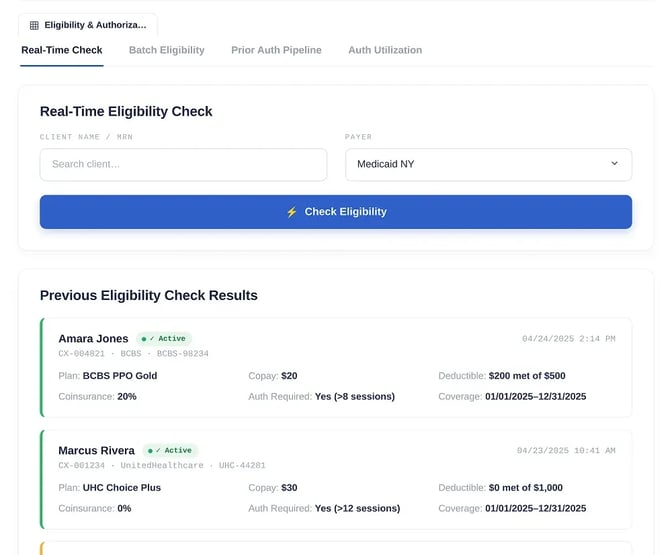
For many behavioral health and IDD organizations, authorization management relies on a combination of manual tracking, staff memory, and spreadsheets that are perpetually a few days behind. The consequences — expired authorizations, services rendered without coverage, denials based on utilization — are expensive and often avoidable.
The Command Center addresses this through its Eligibility & Authorization functionality. Real-time and batch eligibility checks give billing staff current coverage status across the caseload. Authorization utilization tracking surfaces flags when sessions are running ahead of pace or approaching expiration, all without navigating to a separate chart or cross-referencing an external system.
For IDD organizations in particular, where service authorizations can span multiple programs, funding sources, and state-specific requirements, this kind of consolidated visibility is something most behavioral health and IDD EHR platforms have not delivered.
Denial Management Built for Recovery
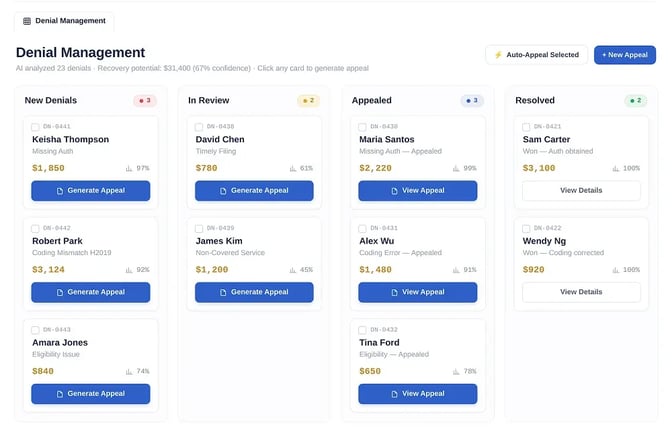
When denials occur, the Command Center is designed to accelerate the response. Its Denial Management capability generates AI-assisted appeal letters individualized to each case, drawing on diagnosis information, medical necessity documentation, and the specifics of the denial reason. Available templates include:
-
Timely filing appeals
-
Coding correction appeals
-
QC-related submissions
Letters can be submitted directly to the payer from within the system or printed for fax or mail submission.
Claims Management and AR Prioritization
The Claims Management feature gives revenue cycle teams the ability to organize and filter their claims inventory by payer, program, or biller, so that all denials from a specific payer can be assigned to a single staff member, or a particular program's outstanding claims can be prioritized for review. Work queues are configurable based on agency-defined criteria — priority level, payer, or exception type — automatically routing flagged claims and denials to the appropriate billing staff. As payer requirements change, prioritization rules can be adjusted without rebuilding workflows from scratch. Critical claims and appeals are surfaced first.
Correcting Claims Without Leaving the Workflow
When a claim needs correction before resubmission, the Rebilling Intelligence capabilities identifies correctable claims and allows billing staff to make adjustments directly within the Command Center. A biller can open the claim form and modify the relevant fields — a modifier, a billing loop, a code — without exiting to a separate view or system.
This capability is scoped appropriately: billing staff can correct billable elements within their purview, while clinical documentation maintains its integrity separately. Access controls keep the workflow efficient without compromising what needs to stay protected.
The Revenue Forecaster: From Reactive to Proactive
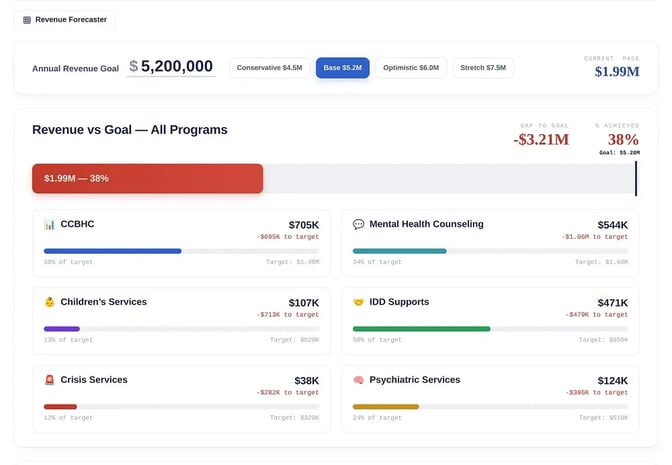
Perhaps the most significant capability within the Revenue Cycle Command Center is the Revenue Forecaster — a planning tool that reorients how behavioral health and IDD organizations approach financial strategy.
Most RCM analysis looks backward: a review of how last quarter performed, followed by adjustments for the next one. The Revenue Forecaster operates differently. Organizations set an annual revenue goal and break it down by program and service line. AI identifies the primary drivers of revenue performance across those programs — active caseload, average service frequency, collection rate — and shows in real time how each is contributing to the overall goal.
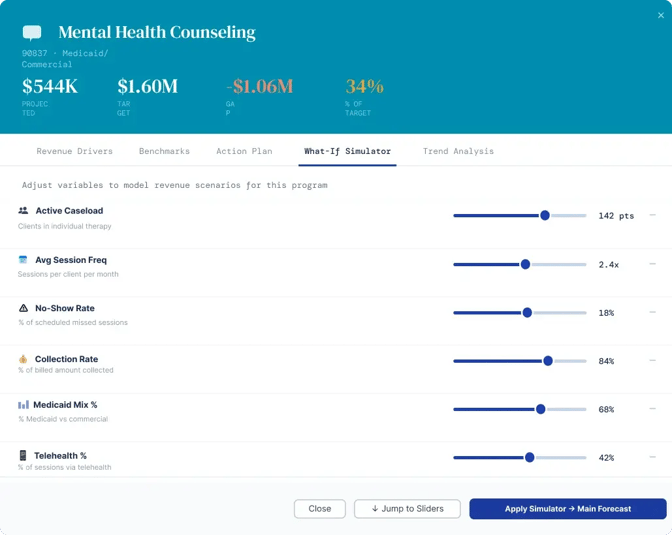
When a gap exists between current trajectory and target, the Revenue Forecaster's What-If Simulator allows leadership to model the impact of specific changes before making them. Some examples of what the tool enables organizations to track include:
-
Active caseload by program or service line
-
Average session frequency per client
-
No-show rate
-
Collection rate
-
Medicaid vs. commercial payer mix
-
Telehealth percentage of total sessions
The simulator projects how each adjustment would affect the gap between current performance and revenue goals, giving financial leaders a forward-looking framework for decision-making rather than a retrospective one. For a CFO managing multiple programs across a complex organization, this kind of scenario modeling has traditionally required outside consultants or custom-built tools. Within the Intelligent Care Record, it is part of the platform.
A New Standard for Behavioral Health Finance
Behavioral health and IDD organizations are increasingly asked to demonstrate value in clinical terms: improved outcomes, stronger engagement, reduced crises. Those outcomes matter, and the Intelligent Care Record is built to support them. Financial sustainability is what makes the mission possible. Organizations that cannot manage their revenue cycle with precision cannot sustain the growth, staffing, and service capacity the individuals they serve require.
The Revenue Cycle Command Center brings the visibility, intelligence, and workflow efficiency that revenue cycle leaders need into a single, purpose-built environment — with AI embedded in the foundation rather than layered on top.
Ready to see the Revenue Cycle Command Center in action? Schedule a demo of Cx360 Intelligence and see how the Command Center can strengthen your organization's financial performance.
Frequently Asked Questions About the Revenue Cycle Command Center
What is the Revenue Cycle Command Center?
The Revenue Cycle Command Center is a unified application within Cx360 Intelligence: The Intelligent Care Record that consolidates the core functions of behavioral health and IDD revenue cycle management — eligibility verification, claim scrubbing, authorization tracking, denial management, AR management, and revenue forecasting — into a single, AI-native environment. Rather than navigating between separate tools or utilities, finance and billing staff access everything they need from one place.
Who is the Revenue Cycle Command Center designed for?
The Command Center is built for the financial and operational leaders of behavioral health and IDD organizations: CFOs, revenue cycle directors, billing managers, and operations staff responsible for the organization's financial performance. It gives decision-makers real-time visibility into where revenue is being lost, where opportunities exist, and what actions are most likely to improve financial outcomes.
How is this different from standard RCM dashboards?
Most behavioral health and IDD EHR platforms offer separate dashboards for different areas of RCM — one for AR, another for denials, another for eligibility — requiring staff to move between views to get a complete picture. The Revenue Cycle Command Center consolidates those views into a single environment, with AI surfacing alerts, scoring claims, and identifying opportunities across all areas simultaneously. The Revenue Forecaster and its What-If Simulator go further, enabling organizations to model the financial impact of operational changes before making them — a capability that is not standard in behavioral health and IDD EHRs.
How does AI function within the Command Center?
AI within the Command Center operates as an analytical and decision-support layer. It scores claims for submission readiness, surfaces alerts around authorization utilization and denial patterns, generates individualized appeal letters, and identifies primary revenue drivers through the Revenue Forecaster. AI surfaces information and flags opportunities — the decisions about what to act on, and how, remain with the finance and revenue cycle professionals using the platform.


One email a month from Core. Product updates, tips, and news, straight to your inbox.
